Tag: fitness

  • Questions for Dance Reflections

    Reflection is a powerful tool for growth, especially in dance. Reflecting on your experiences can deepen your understanding of the skills, techniques, and creativity explored in the dance studio. It’s an opportunity to celebrate your progress, acknowledge challenges, and consider how to use what you’ve learned moving forward.

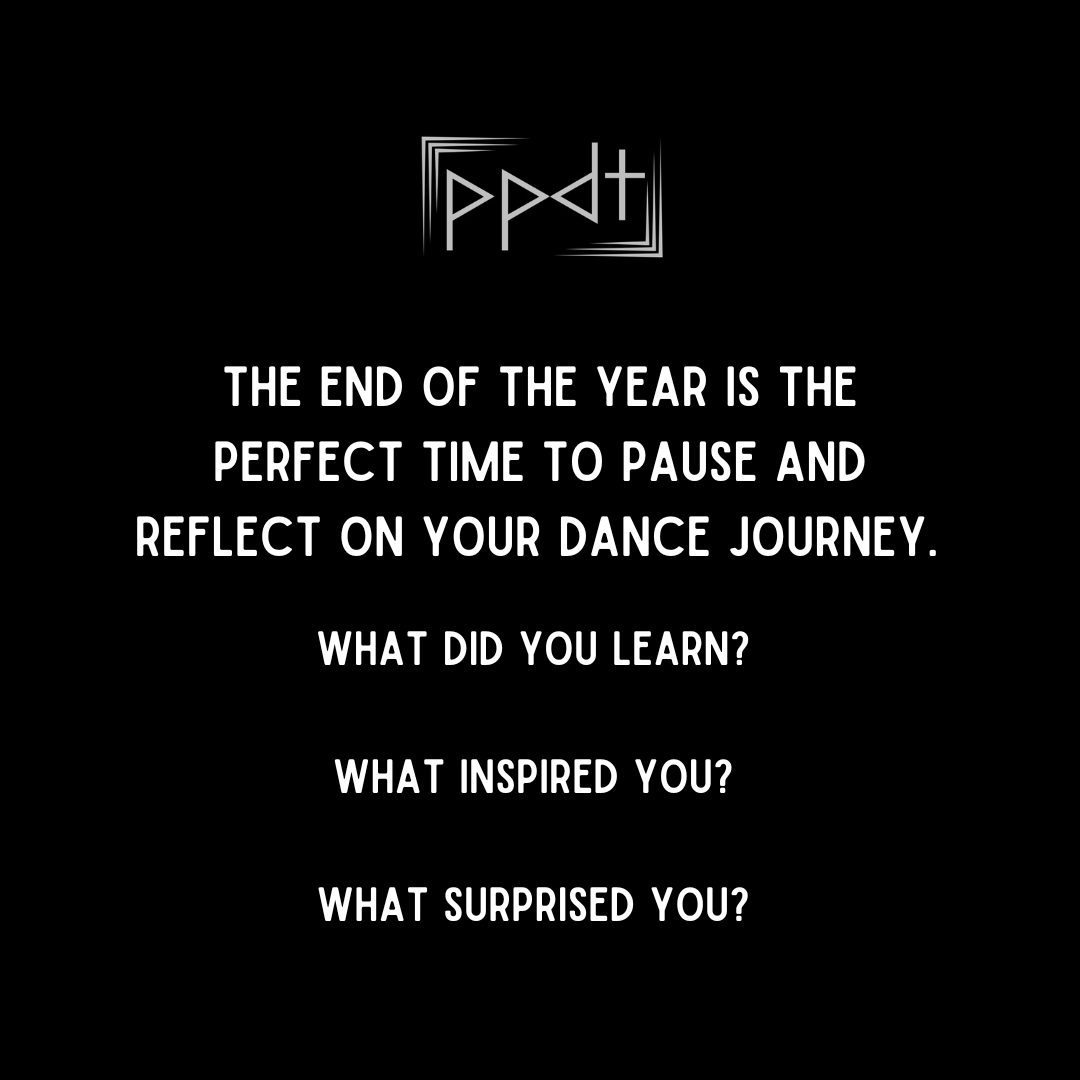
    The end of the year (or semester or term) is the perfect time to pause and reflect on your dance journey. What did you learn? What inspired you? What surprised you? These reflections can also help your dance instructors design future classes tailored to their students’ needs and interests.

    Below are some questions to guide your reflection. You can also download and print a FREE Copy in the People Play Dance Theatre shop.

    Use these questions to help guide a written assignment, course surveys, or video journal. Feel free to adapt them to suit your own dance experiences:

    • Why did you decide to take a dance class?
    • What expectations did you have coming into the class?
    • Did your experience meet your expectations? Why or why not?
    • What skills, styles, or techniques were you hoping to learn (or learn more about)? Were they covered to your satisfaction?
    • What skills, styles, or techniques would you have liked to explore that weren’t covered?
    • What was your favorite unit, style, or routine? Why?
    • What was your least favorite? Why?
    • What aspect of class felt the easiest for you? Why?
    • What was the most challenging part of the class? Why?
    • Describe a moment when something clicked for you – a movement, concept, or correction that strongly resonated.
    • Was there a moment in class that you’d like to do over? What would you do differently?
    • Share a moment when you felt proud of your dancing.
    • Did you have a favorite partner or group to work with? Why?
    • What was the most memorable moment you had in a dance class?
    • What is one thing you know now that you didn’t know before taking the class?
    • How can a lesson you learned in dance class be applied to your everyday life?
    • Would you take another dance class in the future? Why or why not?
    • What advice would you give to someone taking their first dance class?

    By reflecting on these questions, you can celebrate your growth as a dancer and consider how to keep evolving in your dance journey.

    Looking for more dance reflection resources? Check out our shop!

  • A Recipe for Consistent Dance Practice Routines

    Staying consistent with at-home dance practice can be a challenge. Not only is there no teacher present to guide and prompt your steps, but there is also nobody checking to see what is right or wrong with those steps.

    While practicing dance at home can be a challenge, it is not impossible, and I have a few tips that can help make it easier to develop your routine. For the most part, I will structure my at-home practice as if it were an in-person class, but I can tailor the exercises to meet my needs for that day.

    You can join me in using this repeatable recipe for every dance practice session:

    • Warmup
    • Technique practice
    • Choreography or Improv
    • Stretch
    • Log my notes

    One reason I like having a standard list to turn to is that I have a reference of options to choose from. There may be days when I only have 20 minutes to practice, or may only be practicing for the sake of running through choreography. There have been many times when I just jump in to practice and do the thing, but I’ve learned that on the fly means I would be leaving off some of the important parts.

    Warmup

    Warming up is one of the most important parts of your dance practice. With a proper warmup for dance practice, you will be less likely to experience injury and soreness. An ideal warmup includes moving all parts of the body, and light stretching with a focus on preparing for the technique and choreography for the day.

    Technique practice

    Practicing techniques may look different depending on which style of dance you are working on. For ballet, for example, technique practice may look like a full barre or a series of targeted barre drills. If you are a ballroom dancer, you may take to the bar or wall to practice the feeling of resistance you may have with a partner. When it comes to practicing dance techniques on your own without a dance teacher, it can help to focus on repeating and solidifying what you have already learned, rather than trying to get ahead.

    Choosing which technique to focus on will relate to either what you’re working on in class, personal goals you say, or even both.

    Choreography or Improv

    You may not always have a routine or choreography to practice, depending on your dance goals. Choreography run-throughs of whatever I may be working on at the time, and if not, I will throw some improv into the mix. The reason for this is that mentally, practicing technique and drills translates to dance moves.

    Stretch

    I already mentioned warming up as a necessary part of a dance practice session. Stretching is also important. While I do include stretching as a part of the warmup, I also like to add additional stretching after I have been moving. This also makes for a great cool-down after practice or class.

    Log your dance notes

    At the end of the practice session, I log my notes into my dance diary. This allows me to reflect on any challenges, or celebrate successes, and I can also see how consistent I am in showing up.

    While each dance practice session will differ in the specific tasks and details, keeping a broad outline of what to include in your practice can help with the planning.

  • 3 Ways to Add More Mindfulness into Your Dance Journey

    You have probably heard it said that dance is a great way to stay in shape and feel good, but when we are aiming for professional-level training, some of those feel-good experiences may turn sour.

    These mindful practices are nothing new for dancers. In fact, we use them regularly during classes, but to bring attention and to notice allows for a more functional tool. 

    I wrote this post to share a few ways you can tap into mindful practices without needing to add any extra training to your schedule. 

    Breath

    We all need to breathe in order to stay alive. But how often do you think about your breath? How often do you notice the power? 

    Try this:

    When you find yourself becoming fatigued during an exercise class, try to focus on slowing your exhale while channeling the energy into where it feels rough. 

    Tapping Check-in 

    How often have you been physically in a dance class but mentally someplace else? Or how about this one, you are present in the class and thinking about the exercises, but also criticizing your own dancing while you are practicing. 

    Try this:

    When you notice yourself in a place of overthinking, give yourself a small double tap someplace on your body. You can link this tap with a message to come back. 

    Eyes Closed

    Have you ever found that you are able to perform just fine in a dance class, but once you get home, you can’t remember any of the combinations or exercises? It’s likely you don’t actually know what you’re doing in the class, and you are watching others and relying on their presence. 

     The good news is that noticing what you don’t know is actually a mindfulness practice. 

    And even better news is you don’t have to wait until you go home to realize that you have forgotten a portion of the combination. You can find those gaps during class and take action to fill in the gaps before you get home so you have something more solid to anchor your practice. 

    Try this: 

    When learning a new combination, take a moment to close your eyes and visualize the movement in your mind. It’s likely you won’t get through the entire combination on the first try, but you will find the blank spots. 

    These are a few ways to add more mindfulness to your dance practice. Try them out during your next dance class, and remember to have fun with them! 

  • Level Up Your Home Dance Space

    Dancing at home is a great way to supplement your in-person practice, and even learn a few new steps. The problem is, that it’s not always easy to find the right space to dance at home.

    This post will take you through the ideal, set up for an at-home dance studio, and share some alternatives for what you can do when the ideal isn’t available.

    Full Range of Motion

    First and foremost, you need space to move in! This is unfortunately one of the hardest things to come by depending on your living arrangement and practicing in too confined of a space can have a negative impact on your range of motion. A garage space or lawn can be great alternatives if you don’t have enough room indoors.

    A Good Foundation

    Floors are one of the most important things for dancers to pay mind to. Unfortunately, most homes were not built with dance training in mind, and I would especially recommend against practicing on tile or concrete for prolonged periods. Fortunately, there are many options on the internet for portable dance flooring that can be used in small spaces. I have had much success in the past with an area rug in a garage space.

    Meet me at the Barre

    One of the greatest things you will ever bring into your home dance space is a solid barre. There are many portable options available online, or you can also make your own. I made my own glow-in-the-dark galaxy barre using a design I found online. Both options can be pricey, but there are also many household hacks that work too. I won’t be the first to tell you about how great the kitchen counter is as a barre.

    Look at Yourself

    Mirrors are essential for checking your alignment and body positions while dancing. Ideally, your mirror will be full length, but you may also find that multiple smaller mirrors at different angles work better for your space. I have also used my phone camera as a last resort when I’ve lived in apartments with no mirrors.

    Feel the Beat

    Every dancer has their own preference on how to set up their music and media. My biggest recommendation is that whatever you use, make sure you’ve got a designated raised-up space that keeps your devices off the dance floor. I have a tiered shelf that I like to use because I can keep my sound statin on top, and organize some extra accessories so I have more floor space to use.

    Check out this video to learn more!

  • How to Set Smarter Goals for your Dance Practice

    When it comes to creating a solid plan to reach your dance dreams, the more specific you can get, the more likely you are to be successful. A concept I learned from my studies in social media strategy is to set S.M.A.R.T. goals. While your dance goals are likely much different than the digital marketing goals of a business, the concept can still be applied to help improve achievement and success.

    What is a S.M.A.R.T. goal?

    A S.M.A.R.T. goal clarifies what you expect and the measures used to determine if the goal has been reached.

    Specific: Linked to a job description, departmental goals/mission, and/or overall social media goals and strategic plans.

    Measurable: The success toward meeting the goal can be measured in some way.

    Attainable: Goals are realistic and can be achieved in a specific amount of time and are reasonable.

    Relevant: The goals are aligned with current tasks and projects and focus in one defined area; including the expected result.

    Time-Oriented: Goals have a clearly defined time frame including a target or deadline date.

    Here are a couple of examples to show you how to create smarter goals:

    Not a S.M.A.R.T. goal:

    Join a dance company.

    This goal does not identify any measurement or time frame nor why the goal is important.

    S.M.A.R.T. goal:

    This weekend, I will list 5 to 10 local dance companies I could be a good fit for and note their audition criteria. The basic search criteria for each company will be that they perform throughout the year and offer pay so the opportunity is sustainable for my career.

    Not a S.M.A.R.T. goal:

    Get better leg extension.

    What specifics might be missing from this goal?

    S.M.A.R.T. goal:

    Create a simple leg workout and stretch routine that I can complete 3–5 times each week. The routine will consist of strength training exercises as well as stretching so that I have a good foundation to support my leg extensions in dance class.

    With SMART goals, you are more likely to know if your current approach is working or not. Think about how you might apply this process to your dance classes and practice sessions. What S.M.A.R.T. goals will you be setting?

    To help you get started on setting S.M.A.R.T. goals for your dance journey, we have created a free S.M.A.R.T. Goals Worksheet. It is available to download in the People Play Dance Theatre shop.